
Overview
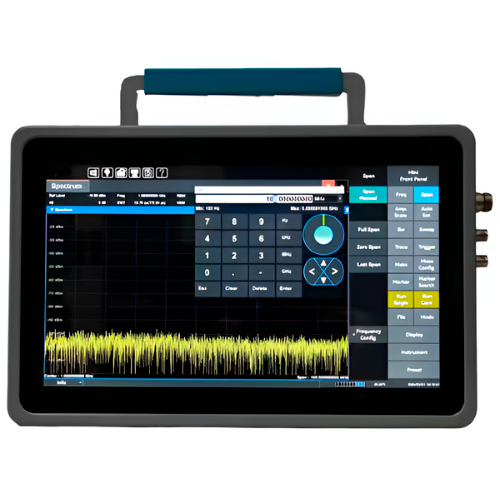
Specimen Track high precision iot signal analyzer with multi-band support is a signal analyzer that utilizes advanced algorithm software combined with a high-performance signal analysis module to achieve efficient and fast signal demodulation, with multiple advantages such as wide working frequency band, high performance index, fast scanning speed, multiple test functions and easy operation, etc. In terms of performance indexes, it has excellent average noise level, phase noise as well as scanning speed, and in terms of measurement functions, it has spectrum In terms of performance indexes, it has excellent average noise level, phase noise and scanning speed, and in terms of measurement functions, it has spectrum analysis, vector signal analysis and 5G NR, NB-IoT, C-V2X, LTE, Wi-Fi, GSM, Bluetooth, etc. communication signal analysis functions, WCDMA, etc. It adopts LCD touch capacitive screen operation, which improves the clarity of display and convenience of operation. It can be widely used in signal analysis and equipment testing in IoT communication, 5G wireless communication, aerospace, satellite communication, university research and teaching.
Technical Specifications
| Type | Signal Analyzer | |
| Customized Support | OEM | |
| Material | Plastic, etc | |
| Overall Power Consumption | ≤60 W | |
| Frequency Range | 9 kHz to 6.3 GHz or 9 GHz or 20 GHz | |
| Frequency Accuracy | ±(0.05 ppm + 5 Hz) | |
| Reference Level | -130 dBm to 30 dBm | |
| Real-Time Analysis of Bandwidth | Max. 100 MHz | |
| Average Noise DisplayLevel (Amplifier Off) | 100 kHz to 50 MHz: -142 dBm/Hz 50 MHz to 6.3 GHz: -148 dBm/Hz 6.3 GHz to 9 GHz: -148 dBm/Hz 9 GHz to 20 GHz: -145 dBm/Hz |
|
| Average Noise Display Level (Amplifier On) | 100 kHz to 50 MHz: -145 dBm/Hz 50 MHz to 6.3 GHz: -164 dBm/Hz 6.3 GHz to 9 GHz: -161 dBm/Hz 9 GHz to 20 GHz: -160 dBm/Hz |
|
| Level Accuracy | ±1.0 dB (CW Typical) | |
| Level Resolution | 0.1 dB | |
| Max. Input Safety Power | 26 dBm (100 kHz to 6.3 GH) 25 dBm (100 kHz to 9 GHz/20 GHz) |
|
| Third-Order Intermodulation Intercept Point | 100 kHz to 3 GHz: ≥±10 dBm 3 GHz to 6.3 GHz: ≥±12 dBm |
|
| Second Harmonic Suppression | <-60 dBc | |
| Residual Response | ≤ -80 dBm 30 MHz to 6.3 GHz ≤ -76 dBm 6.3 GHz to 9 GHz ≤ -72 dBm 9 GHz to 20 GHz |
|
| Standing Wave Ratio | <2.0 | |
| Demodulation Analysis Support Mode | 5G NR, LTE, NB-IoT, WCDMA, GSM, WIFI, Bluetooth, Generic vector signals | |
| Reference Frequency | 10 MHz Internal or external 10 MHz Internal time base aging 10 MHz Internal time base temperature drift |
|
| 5G NR Testing | Modulation Mode | QPSK, 16QAM, 64QAM, 256QAM |
| Subcarrier Spacing | 15 kHz, 30 kHz, 60 kHz | |
| EVM | ≤1.0% (100 MHz @3.5 GHz) | |
| Signal Analysis Function | Error vector analysis (EVM), magnitude error (ME), phase error (PE), frequency error, IQ bias, mean power, peak power | |
| LTE (including TDD, FDD) Testing | Modulation Mode | QPSK, 16QAM, 64QAM, 256QAM |
| Typical EVM | ≤1.8% (20 MHz @3.5 GHz) | |
| Signal Analysis Function | Error vector analysis (EVM), magnitude error (ME), phase error (PE), frequency error, IQ bias, mean power, peak power |
|
| NB-IoT | Physical Channel | NPSS, NSSS, NPBCH, NPDCCH, NPDSCH |
| Typical EVM | ≤1.5% RMS | |
| WCDMA | Test Items | Symbol EVM, signal power, channel power, channel power error, frequency error, amplitude error, phase error, IQ bias, etc. |
| Typical EVM | ≤2% RMS | |
| GSM/EDGE | Signal Analysis Function | Error vector analysis (EVM), magnitude error (ME), phase error (PE), frequency error, IQ bias, power test |
| Typical EVM | ≤1.2% RMS | |
| WI-FI | Standard | IEEE 802.11a or g or n or ac or ax |
| Test Items | Power, EVM, FreqError, IQ-offset, TSM, BER | |
| Bandwidths | 20 MHz, 40 MHz, 80 MHz | |
| Modulation Mode | BPSK, QPSK, 16QAM, 64QAM, 256QAM, 1024QAM | |
| Typical EVM | ≤1.6% RMS | |
| Bluetooth | Test Items | DEVM, PvT, constellation diagram, ACP, frequency error, etc. |
| Generic Vector Signals | Modulation Mode | BPSK, QPSK, 8PSK, 16QAM, 32QAM, 64QAM, etc. |
| Coding Rate | 10 ksps to 20 Msps | |
| Pulse Forming Filters | Gaussian, ascending cosine, square root ascending cosine | |
| Filtering Factor | 0.2 to 1, Step 0.01 | |
| Typical EVM | 1.2% @1.8 GHz (code rate 1 Msps QPSK or 64QAM) | |
| Power Input Type | AC: 220 V ± 10%, 50 Hz ± 5% DC: 12 V | |
| Test Port | RF input: N-type connector (female) | |
| Other Interfaces | 10 MHz reference input: BNC female connector Trigger input: BNC female connector USB: USB3.0 × 1, USB2.0 × 1 LAN: 1pc |
|
| Operation Temperature | 32 °F to 104 °F (0 °C to 40 °C) | |
| Storage Temperature | -4 °F to 140 °F (-20 °C to 60 °C) | |
| Size | 14.17 in × 11.33 in × 1.73 in (36 cm × 28.8 cm × 4.4 cm) (excluding handles) | |
| Weight | ≤9.47 lb (≤4.3 kg) | |



Reviews
There are no reviews yet.